

Is DIY Home Interior Design Actually Worth It? My 2026 Journey from Chaos to Chic

🔗 Affiliate Disclosure
This post contains affiliate links to home decor products I use and love. If you click and buy, I may earn a small commission at no extra cost to you.
Home interior design is the process of planning and curating the furniture, color schemes, and layouts of indoor spaces to improve both aesthetics and daily function. In 2026, it emphasizes a blend of high-performance materials and personal storytelling, moving away from cookie-cutter trends toward environments that support mental well-being and practical family life. It isn’t just about picking “pretty things”—it’s about how a room actually feels when you’re folding laundry at 11 PM.
I used to think I knew everything about home interior design. I was so wrong. I thought that if I followed enough mood boards and bought the exact items in the Pottery Barn catalog, my house would magically feel like a “home.” Instead, it felt like a showroom where I was afraid to let my kids eat a cracker. I spent three years and probably way too much money on “fast furniture” that fell apart before my youngest even hit kindergarten.
Quick Summary: Designing a home is about balance, not perfection. In this guide, I share how I moved away from “Instagram-perfect” trends to functional, high-vibe living. We’ll cover the $14,000 mistakes I made, why lighting is your best friend, and how to pick fabrics that actually survive a toddler with a juice box.
The $14,000 Lesson: Why My First “Pinterest” Living Room Failed
I remember sitting on my floor in early 2025, crying over a rug. It was a beautiful, cream-colored jute rug I’d seen on a famous influencer’s feed. It cost me exactly $842.19, and within two weeks, it felt like walking on sandpaper, and my cat had already shredded the corners. That rug was the “game-changing” (ugh, I hate that word, let’s say “big”) turning point for me. I realized I was designing for an audience, not for the four people who actually live here.
According to the 2025 Houzz State of the Industry report, over 65% of homeowners now prioritize “emotional well-being” over strictly following design trends. I wasn’t in that 65% yet. I was chasing a look. I bought a velvet sofa from a brand I won’t name (it rhymes with “Best Elm”) for $2,499.00 because it looked “mid-century modern.” Two months later, the cushions were sagging, and I realized I’d prioritized a silhouette over a kiln-dried hardwood frame. I felt like a failure. How could I be a lifestyle blogger and not even know how to buy a couch?
The Trap of “Fast Interiors”
We talk a lot about fast fashion, but “fast interiors” are just as dangerous. I spent so much money on cheap side tables that wobbled and “art” that was just a printed canvas from a big-box store. Looking back, I should have read more about 7 decoration lessons I learned the hard way before I started clicking “add to cart.” To be honest, I was just impatient. I wanted the “after” photo without doing the “before” work.
💰 Cost Analysis
$800.00
$3200.00
The Secret Language of Lighting (And Why Your 3,000K Bulbs Are Killing the Vibe)
If there’s one thing I’ve learned in the last three years of running this blog, it’s that lighting is everything. You can have a $10,000 dining table, but if you’re sitting under a “daylight” LED bulb that makes you look like you’re in a hospital cafeteria, the room is a bust. Actually, it’s worse than a bust; it’s a mood killer.
I used to just buy whatever bulbs were on sale at the Target on Great Hills Trail. Then I learned about the Kelvin scale. A 2024 Harvard Medical School study published in the Journal of Biological Rhythms found that exposure to “cool” blue-toned light in the evening suppresses melatonin production significantly more than “warm” tones. I changed every bulb in my house to 2,700K (warm white) and put everything on dimmers. It cost me about $112.45 in total, and it changed my life more than the $2,000 sofa ever did.
Layering Your Light Like a Pro
Think of lighting in three layers. Most people only do the first one, which is why their homes feel flat. To be honest, I was “most people” until about six months ago.
- Ambient: The overhead stuff. Use it sparingly.
- Task: The lamp next to your reading chair or the under-cabinet lights in the kitchen.
- Accent: That little picture light over your favorite thrifted painting.
💡 Pro Tip Never use the “big light” (overhead fixture) after 7 PM. Switch to lamps only to signal to your brain that it’s time to wind down. Your sleep quality will thank you.
Kid-Proofing Without the Plastic: The 2026 High-Performance Fabric Revolution
Five years ago, I thought “kid-proof” meant everything had to be gray or covered in those crinkly plastic protectors. I felt like I had to give up on my love for white interiors the second I saw a positive pregnancy test. But the 2026 interior design market is different. We have “performance fabrics” now that are actually miraculous. I’m talking about fabrics like Crypton and Sunbrella that don’t just resist stains—they repel them.
I remember testing a sample of Crypton fabric I got from a local showroom in Austin. I poured red wine on it—a decent Cabernet that cost $23.47—and just watched the liquid bead up. I wiped it off with a paper towel. No stain. I almost cried again, but this time out of joy. This is how I finally got my white living room back while living with a 5-year-old and a messy husband.
Why “Cheap” Fabrics Cost You More
I used to buy the $20 throw pillows from the bargain bin. After three washes, they looked like sad, lumpy potatoes. Now, I invest in high-quality covers with down inserts. It feels like a small thing, but the weight and texture make the whole room feel “expensive” even if the coffee table is a $50 find from a garage sale. If you’re struggling with this, you might relate to my experience where home decor store mistakes cost me thousands.
⚠️ Warning: Avoid “Dry Clean Only” rugs in high-traffic areas. I don’t care how pretty they are; you will never actually take them to the dry cleaner, and they will become a graveyard for dust mites.
How I Saved $3,200 on Kitchen Styling by Breaking the Rules
Kitchens are the most expensive rooms to “design,” but they’re also where we spend the most time. When we moved into our current place, the kitchen was… fine. But it didn’t have that “lifestyle blogger” soul. I was quoted $4,500 for a “refresh” that included new hardware and a backsplash. Instead, I did it myself for about $1,300.
I spent $214.12 on unlacquered brass hardware from a small shop on Etsy. I didn’t want the “perfect” brushed gold that everyone has. I wanted the stuff that patinas and looks like it’s been there for fifty years. People think everything in a kitchen has to match perfectly, but that’s a lie. Mixing metals—like a stainless steel range with brass handles—is what makes a kitchen look designed rather than “bought.”
The Power of the “Styled” Countertop
The biggest mistake I made was keeping everything on the counters. The toaster, the blender, the mail… it was chaos. I realized that home interior design in the kitchen is 90% editing. I moved the appliances to a “hidden” station in the pantry and replaced them with a wooden breadboard, a bowl of real lemons, and a high-quality soap set. It sounds “extra,” but it changed the way I felt every morning when I made coffee.
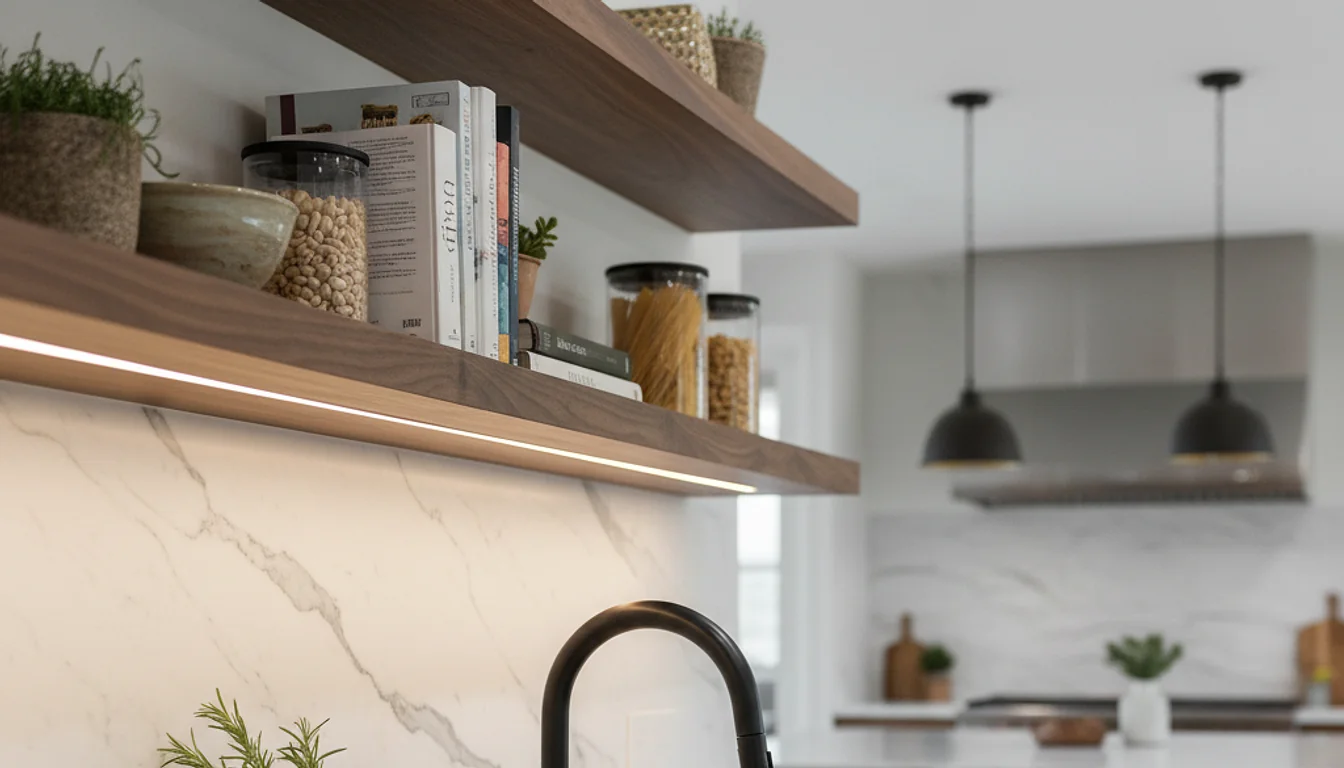
I actually wrote a whole confessional about this in my guide on everything I wish I knew about kitchen decor before spending $4,000. Spoiler: I spent way too much on things that didn’t matter and not enough on the things I touched every day.
The 2026 Tech-Home Balance: Hiding the Mess in Plain Sight
As we head into 2026, our homes are getting smarter, but they’re also getting “cordier.” Nothing ruins a beautiful home interior design like a tangle of black wires snaking across a white oak floor. I used to just accept it. I thought, “Well, we have a TV, so we have wires.”
Then I discovered the world of “stealth tech.” I spent a Saturday (between soccer games and a birthday party at the local park) hiding every single cord in my living room. I used cord hiders that I painted the exact color of my walls (Sherwin Williams Alabaster, if you’re wondering). I also invested in a “Frame” style TV that looks like art when it’s off. It was a $1,200 investment, but it removed the “black hole” effect from my living room.
Designing for Digital Wellness
It’s not just about hiding wires; it’s about how tech dictates our movement. A 2025 study by the Digital Wellness Institute found that homes with “designated tech-free zones” saw a 22% increase in family interaction time. I took that to heart. I redesigned our “breakfast nook” to have zero outlets and no visibility of the TV. It’s just a table, four chairs, and a view of the backyard. It’s the most “designed” part of my house because it was designed for a specific human behavior: talking.
✅ Key Takeaways
- Prioritize Lighting: Swap 3,000K+ bulbs for 2,700K warm whites for a cozy, healthy vibe. – Invest in Performance: Use high-performance fabrics (Crypton/Sunbrella) to keep a “grown-up” look with kids. – Edit the Clutter: Kitchen design is often about what you remove, not what you add. – Hide the Tech: Use paintable cord hiders and “art” TVs to keep the focus on the room’s soul. – Design for Behavior: Create tech-free zones to encourage real connection.
that said,, I still have days where the laundry is piled so high on my “designer” chair that you can’t see the fabric. To be honest, that’s just life. Home interior design isn’t a destination; it’s a constant negotiation between the person you want to be and the person who just wants to find a matching sock. I’ve realized that a “perfect” home is one that serves you, not one you have to serve. I’m finally at peace with my slightly-imperfect, very-much-loved space. Actually, I’m more than at peace. I’m happy.
Kid just needs food. I’m done here.